Most startup post-mortems cite “running out of money” as the cause of death. That is a lazy diagnosis.
Running out of cash is merely the final symptom. The actual disease is almost always an operator who mistook an accounting projection for spendable cash, looked only at net burn, and woke up to find their runway had been cut in half overnight.
When revenue looks steady, tracking cash feels straightforward. You look at your monthly burn, divide your bank balance by that number, and tell your board you have eighteen months of breathing room.
Then a major enterprise client delays payment by sixty days, your top customer churns, and that clean eighteen-month runway collapses into eight.
Navigating this reality requires understanding both gross burn and net burn. They are not competing metrics, and one is not superior to the other. They answer two entirely different questions about your survival.
The Core Definitions: Cash Out vs. Cash Gone
To measure burn accurately, you must ignore traditional accrual accounting. Your Profit and Loss (P&L) statement tracks when revenue is earned and when expenses are billed. Your bank account only cares about when currency actually enters or leaves your custody.
+-----------------------------------------------------------------------------------+
|                              GROSS BURN RATE                                      |
|                                                                                   |
|  Total Cash Leaving Your Accounts in a Single Month (Operating Cash Outflow)      |
|  [ Payroll + Rent + Servers + Vendor Invoices + GST/Taxes Paid + Contractors ]    |
+-----------------------------------------------------------------------------------+
                                         │
                                         ▼  MINUS
+-----------------------------------------------------------------------------------+
|                        ACTUAL CASH COLLECTIONS                                    |
|                                                                                   |
|  Money That Actually Hit Your Account (NOT Booked/Invoiced Revenue)               |
+-----------------------------------------------------------------------------------+
                                         │
                                         ▼  EQUALS
+-----------------------------------------------------------------------------------+
|                               NET BURN RATE                                       |
|                                                                                   |
|  The Net Depletion of Your Total Cash Reserves in a Given Month                   |
+-----------------------------------------------------------------------------------+
What Is Gross Burn?
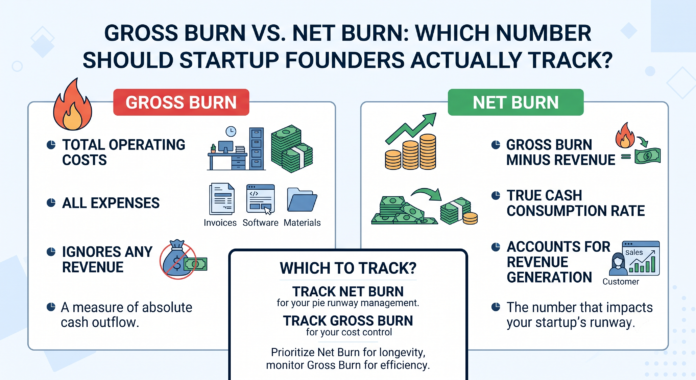
Gross burn is your monthly cash outflow, full stop. It is the total volume of money exiting your company’s accounts to keep the operation running, calculated without factoring in a single rupee or dollar of incoming revenue.
$$\text{Gross Burn Rate} = \text{Total Monthly Cash Outflows}$$
This includes everything:
- Net salaries and founder draws
- Statutory employee obligations (such as PF, ESI, or payroll taxes)
- Direct tax deposits (such as TDS)
- Cloud infrastructure, tools, and SaaS licenses
- Commercial lease, coworking passes, and utility bills
- Vendor invoices and marketing ad spend (inclusive of input GST or sales tax paid)
- Retainers for legal, auditing, and outsourced support
Gross burn answers a blunt, defensive question: “If our sales engine dropped to absolute zero tomorrow morning, how much cash does this company consume each month just to exist?”
What Is Net Burn?
Net burn is the difference between cash going out and cash coming in. It measures the real-world pace at which your total capital reserves are shrinking.
$$\text{Net Burn Rate} = \text{Gross Burn Rate} – \text{Cash Collected from Operations}$$
Notice the emphasis on cash collected. Net burn cannot be calculated using recognized revenue, booked annual contracts, or accounts receivable. If you closed an enterprise contract for ₹12 lakh a year, but the client negotiates payment on net-60 terms, your cash collections for day one are zero.
Net burn answers an offensive, forward-looking question: “Given our current operational baseline and real revenue collections, how many months of life does this business have left?”
The Operational Comparison
Understanding where these two numbers diverge tells you where your company’s operational risks are hiding.
| Dimension | Gross Burn | Net Burn |
| What It Measures | Total monthly cash outflow across all operations | Net decrease in cash reserves over the calendar month |
| Revenue Treatment | Completely ignored | Directly subtracted (cash collections only) |
| Primary Utility | Cost discipline, overhead analysis, downside planning | Calculating actual survival runway, fundraising pacing |
| Volatility Profile | Low to moderate (largely governed by headcount) | High (swings widely based on collection timing) |
| Investor Perspective | Reveals operational bloat and expense governance | Validates business traction and real capital efficiency |
| Worst-Case Utility | Assumes worst-case scenario (sudden zero revenue) | Assumes ongoing business performance holds steady |
| Best Used For | Stress-testing, severance budgeting, fixed cost control | Board reporting, runway planning, calculating burn multiple |
Why Relying Only on Net Burn Is Dangerous
Because net burn determines your headline runway, founders often treat it as their sole operational compass. That is where problems start.
Net burn hides structural cost inflation. When top-line collections grow, a startup can easily mask an undisciplined, ballooning expense structure under an apparently healthy net burn figure.
The Concentration Trap: A Tale of Two Startups
Consider two seed-stage companies, each with a comfortable cash balance of ₹1.5 crore:
STARTUP A (Lean Overhead)
────────────────────────────────────────────────────────────
Gross Burn:        ₹12 Lakhs / month
Cash Collections:  ₹5 Lakhs / month
Net Burn:          ₹7 Lakhs / month
Runway:            21.4 Months
────────────────────────────────────────────────────────────

STARTUP B (Bloated Overhead)
────────────────────────────────────────────────────────────
Gross Burn:        ₹28 Lakhs / month
Cash Collections:  ₹21 Lakhs / month
Net Burn:          ₹7 Lakhs / month
Runway:            21.4 Months
────────────────────────────────────────────────────────────
On a standard one-page investor update, both companies report identical performance metrics: ₹7 lakh monthly net burn and 21.4 months of runway.
Now simulate a standard market shock: a sudden industry downturn hits, enterprise procurement freezes, or a primary client responsible for 60% of volume churns. Collections drop by half across both accounts.
- Startup A sees collections drop to ₹2.5 lakh. Net burn climbs to ₹9.5 lakh. Their runway shortens to 15.7 months—plenty of time to adjust marketing spend or course-correct product direction.
- Startup B sees collections drop to ₹10.5 lakh. Because their fixed gross commitments remain locked in at ₹28 lakh, their net burn explodes to ₹17.5 lakh. Their runway immediately drops from nearly two years down to 8.5 months.
Startup B is now in emergency fundraising mode in an inhospitable market, forced into structural layoffs because leadership monitored only the net spread rather than the underlying commitments.
The Burn Multiple: How Sophisticated Investors Read Your Burn
As a startup matures past initial customer discovery into product-market fit, modern venture investors stop looking at net burn in isolation. Instead, they look at Burn Multiple—a concept popularized by SaaS investor David Sacks.
The Burn Multiple measures how much net cash a business consumes to generate each incremental dollar of Annual Recurring Revenue (ARR).
$$\text{Burn Multiple} = \frac{\text{Net Burn}}{\text{Net New ARR}}$$
If your company burned ₹1.5 crore in cash over the last four quarters and added ₹1.5 crore in net new ARR, your Burn Multiple is 1.0x. You consumed one unit of cash to create one unit of enduring enterprise value.
                      THE BURN MULTIPLE BENCHMARK

    < 1.0x     |==============================|  Exceptional Efficiency
    1.0x - 1.5x|======================|  Good / Healthy
    1.5x - 2.0x|==============|  Mediocre / Needs Attention
    > 2.0x     |========|  Alarming Capital Destruction
Tracking both burn figures is essential to managing this ratio:
- If your Burn Multiple is higher than 2.0x, looking at gross burn reveals where capital is leaking—excessive seat licenses, unmanaged vendor agreements, or bloated sales pipelines.
- Monitoring net burn ensures your customer acquisition costs (CAC) generate real cash returns rather than paper bookings.
Balancing the Metrics Across Startup Stages
Your focus should adjust based on your current operating stage and revenue predictability.
               WHICH METRIC TAKES PRIORITY OVER TIME?

 [Pre-Seed / Pre-Revenue]  ────────► Focus 90% on GROSS BURN
                                     (Net burn is identical to gross burn)

 [Seed to Series A]        ────────► Track BOTH with a Bridge
                                     (Net burn governs runway; gross burn manages risk)

 [Series B to Breakeven]   ────────► Lead with NET BURN
                                     (Net burn trends to zero; gross burn tracks margin)
1. Pre-Revenue (Idea to Working Prototype)
When a startup has no operating income, gross burn and net burn are identical. The operational priority here is preserving baseline cash:
- Keep fixed commitments variable wherever possible.
- Treat headcount expansion cautiously—payroll will quickly become 70% to 80% of your outgoings.
- Calculate survival runway using gross commitments, and ensure every expenditure directly validates your core hypothesis.
2. Early Revenue Generation (Seed to Series A)
Once customer payments start hitting the bank, split your attention deliberately.
- Lead external reporting with net burn. Investors want to know your current operating trajectory and how many quarters you can push before the next financing round.
- Use gross burn internally to stress-test your balance sheet. Model a “zero-growth” or “major customer loss” scenario once a quarter. If gross burn is expanding faster than gross margins, you are scaling operational overhead ahead of product demand.
3. Growth Stage Approaching Cash-Flow Breakeven
As a business moves toward sustainability, net burn should consistently trend toward zero.
- Net burn serves as the milestone marker for operational profitability.
- Gross burn acts as the sanity check on your operating margins. It tells prospective growth-equity investors whether your business model exhibits true operating leverage or merely requires capital injections to sustain itself.
Practical Playbook for Founders and Finance Leads
Accurate burn management comes down to reliable daily habits, not elaborate financial theories.
1. Reconcile Against Real Bank Accounts, Not Your P&L
Accrual accounting is valuable for auditing, but it will obscure your cash position. Calculate your burn directly from your banking statements and treasury accounts. Every rupee or dollar that leaves the account—whether classified as capital expenditure, operational expense, or statutory tax deposits—is burn.
2. Build an Explicit Burn Bridge for Board Decks
Never report a single net burn figure on your board slides without explaining how you arrived at it. Use a clear bridge format:
  Starting Cash Balance (July 1):      ₹1,40,00,000
  (-) Gross Cash Outflow:             - ₹ 22,00,000
  (+) Actual Collections:             + ₹ 13,00,000
  ─────────────────────────────────────────────────
  (=) Net Cash Burn for July:         - ₹  9,00,000
  Ending Cash Balance (July 31):       ₹1,31,00,000
  ─────────────────────────────────────────────────
  Implied Runway (at current pace):    14.5 Months
  Zero-Revenue Runway (Gross Shock):    5.9 Months
Presenting both figures shows your investors that you manage day-to-day operations with an eye toward downside protection.
3. Review Fixed vs. Variable Costs Semi-Annually
Break your gross burn down into two distinct buckets:
- Inflexible commitments: Rent, core engineering payroll, compliance costs, enterprise software contracts with annual lock-ins.
- Flexible commitments: Performance marketing spend, external contractor budgets, discretionary travel, uncommitted pilot projects.
If flexible costs account for less than 20% of your gross burn, your ability to maneuver during a sudden downturn is severely compromised.
The Operational Verdict
Which number should you track? You must track both, but you use them for completely different jobs.
- Net burn is your operational speedometer. It tells you how quickly your capital reserves are depleting today and anchors your capital-raising schedule.
- Gross burn is your structural structural stress-test. It shows your financial exposure if your commercial assumptions fall apart.
Healthy startups run on genuine cash collections, not optimistic invoicing. Treat net burn as your everyday operating guide, but keep a firm hand on your gross burn—because when a crisis hits, the gap between those two figures determines whether your business survives.
Sources
- SaaS Capital: What Is a Good Burn Multiple for a B2B SaaS Company?
- David Sacks (Craft Ventures): The Burn Multiple Framework
- Y Combinator Library: How to Manage Startup Runway and Cash Burn
Frequently Asked Questions on Gross Burn vs. Net Burn
Can net burn ever be negative?
Yes. When your monthly cash collections exceed your total monthly gross cash outflows, your net burn becomes negative. This indicates that your company is cash-flow positive and generating net cash reserves rather than consuming them.
What is the difference between burn rate and cash runway?
Burn rate measures the speed at which you spend capital (cash per month), while cash runway measures the amount of time remaining until you exhaust your existing capital reserves (months of operations left).
How often should an early-stage startup recalculate its burn rate?
Founders should track gross and net cash outflows on a monthly basis. However, runway projections and cost structure stress tests should be formally evaluated every quarter to smooth out one-off capital expenditures and invoice timing irregularities.