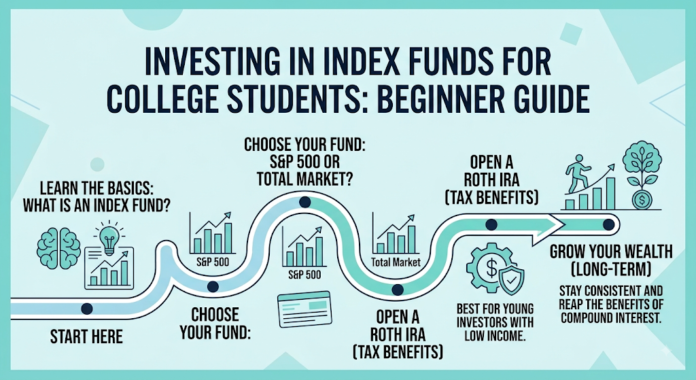
Between textbooks, semester fees, and social lives, the idea of “investing” during college can feel like something reserved for corporate workers with full-time salaries.
Social media feeds do not help. Young adults are constantly bombarded with claims about day trading, quick crypto flips, and high-risk options strategies promising to turn ₹1,000 into a fortune overnight. The reality? Most students who chase speculative trades lose their hard-earned pocket money long before graduation.
If you actually want to build wealth that lasts beyond your college years, the most reliable, stress-free tool available is an index fund.
Whether you are saving ₹500 a month from a part-time internship stipend or managing a modest monthly allowance, index funds allow you to own a piece of India’s top companies without spending hours analyzing stock charts.
This guide breaks down exactly how index funds work for college students, how to navigate legal age requirements, and how to set up your first investment step-by-step.
Why Index Funds Beat Stock Picking for Students
An index fund is a passive mutual fund that tracks a specific stock market benchmark, such as the Nifty 50 or the BSE Sensex. Instead of hiring an expensive fund manager to guess which individual stocks will win, an index fund simply buys all the companies in that index in the exact same proportion.
If you buy a Nifty 50 index fund, your money is instantly split across 50 of India’s largest, most established corporations—spanning banking, technology, consumer goods, and energy.
                    HOW AN INDEX FUND PIPELINE WORKS

 [ Your Monthly SIP ] ──► [ Index Fund Pool ] ──► [ Automatic Allocation ]
      (e.g., ₹500)                                   ├─ TCS / Infosys (Tech)
                                                     ├─ HDFC Bank (Banking)
                                                     ├─ Reliance (Energy)
                                                     └─ 47 Other Top Companies
Why This Architecture Fits Student Life Perfectly
- Ultra-Low Cost: Active mutual funds charge higher management fees (expense ratios) because teams of analysts manually select stocks. Index funds operate automatically, resulting in significantly lower annual fees. Lower fees mean more of your money stays compounded in your portfolio.
- Zero Homework Required: Researching quarterly balance sheets, price-to-earnings ratios, and corporate earnings calls takes dozens of hours every week—time you should be spending on coursework, exams, and skill-building. Index funds handle diversification automatically.
- No Key-Person Risk: If a single company in the Nifty 50 stumbles or goes bankrupt, it gets automatically removed from the index and replaced by the next rising corporate leader. You don’t have to worry about picking “dud” stocks.
The Legal Reality Check: Age, KYC, and the “Minor to Major” Shift
One of the biggest hurdles college students face is understanding the legal rules around opening an investment account. Your operational path depends entirely on whether you are under or over 18 years old:
+------------------------+---------------------------------------+---------------------------------------+
| Rule / Requirement     | Students Under 18 (Minors)            | Students 18 and Older (Majors)        |
+------------------------+---------------------------------------+---------------------------------------+
| Account Type           | Minor Folio (Managed by Guardian)     | Individual Adult Account              |
| Operating Control      | Parent / Legal Guardian holds control | Full independent operational control  |
| Mandatory Identity     | Minor's Birth Certificate + Guardian  | Student's PAN Card + Aadhaar Linked   |
|                        | PAN/KYC                 | Phone                   |
| Bank Account           | Minor Bank Account / Joint Account    | Independent Savings Account           |
| Key Transition Rule    | Must complete "Minor-to-Major" KYC    | Direct online account opening via     |
|                        | immediately upon turning 18     | SEBI-registered platforms       |
+------------------------+---------------------------------------+---------------------------------------+
If You Are 18 or Older
Under guidelines governed by the Securities and Exchange Board of India (SEBI), turning 18 gives you full legal capacity to invest independently. You need:
- A valid PAN Card
- An Aadhaar Card linked to your current mobile number (for instant e-KYC OTP verification)
- An active Savings Bank Account in your name
If You Are Under 18
You can legally own index fund units, but the account must be opened as a Minor Folio registered under a parent or legal guardian. The guardian manages transactions until your 18th birthday.
Important Transition Rule: The exact day you turn 18, the minor account gets temporarily locked for new investments or withdrawals until you submit a fresh “Minor-to-Major” status change form along with your adult PAN and updated KYC details.
Step-by-Step Blueprint: Setting Up Your First SIP
A Systematic Investment Plan (SIP) lets you automatically invest a fixed amount of money—starting as low as ₹100 or ₹500—on a chosen date every month.
1.1. Complete Your Digital KYC:Complete identity verification online in minutes.
Download a SEBI-registered mutual fund platform app or visit a direct Asset Management Company (AMC) portal. Upload your PAN card, Aadhaar details, and a clear selfie to complete Video KYC verification.
2.2. Select the Right Underlying Index:Stick to broad-market large-cap benchmarks first.
As a beginner, avoid narrow sector funds (like Banking or IT-only indices). Choose a broad large-cap index:
- Nifty 50 Index Fund: Covers India’s top 50 blue-chip market leaders.
- BSE Sensex Index Fund: Covers 30 of the largest listed enterprises.
3.3. Evaluate Expense Ratio & Tracking Error:Filter out unnecessary management drag.
When comparing different mutual fund houses offering a Nifty 50 fund, look at two key metrics:
- Direct Plan: Always select the Direct-Growth option (not Regular) to avoid paying ongoing broker commissions.
- Tracking Error: This measures how closely the fund mirrors the index returns. Pick a fund with the lowest tracking error and a low expense ratio (ideally under 0.20%).
4.4. Set Up a Comfortable Monthly SIP:Automate investments to build financial discipline.
Link your savings bank account and pick an auto-debit date 2 to 3 days after you usually receive your monthly stipend or pocket money. Automating the payment removes the temptation to spend the money elsewhere.
Realistic Expectations: What ₹1,000/Month Can Look Like by Graduation
Investing during college is not about getting rich by senior year; it is about establishing a compounding habit while time is on your side.
Consider a 19-year-old college sophomore who starts a modest monthly SIP of ₹1,000 in a Nifty 50 index fund and increases the contribution by just 10% each year as their income grows through internships and entry-level jobs.
                    THE POWER OF STARTING AT AGE 19

 [ Total Out-of-Pocket Invested over 10 Years: ~₹1.91 Lakhs ]

 Projected Portfolio Value at Age 29 (assuming ~12% annualized return):

 ₹0                                                    ₹3.85 Lakhs
 +---------------------------------------------------------+
 | █████████████████████████████████████████████████████ |
 +---------------------------------------------------------+
   ▲                                                       ▲
   |                                                       |
 Initial College Capital                      Compounded Capital Growth
Because equity markets fluctuate in the short term, your portfolio may show temporary losses during your first 6 to 12 months. This is normal. Over 5 to 10-year periods, broad-market index funds historically smooth out short-term volatility.
3 Critical Mistakes College Students Must Avoid
- Investing Your Emergency Fund: Never invest money you need for next semester’s tuition fees, hostel rent, or laptop repairs. Equity index funds are built for 5+ year horizons. Keep short-term expense cash safe in a standard bank savings account.
- Buying “Regular” Plans Instead of “Direct”: Regular plans route your money through distributors, taking a small cut of your investment every year in commissions. Always select Direct Plans to keep 100% of your compounding gains.
- Panic-Selling During Market Dips: When market news turns negative and index values drop, beginner investors often panic and sell at a loss. Market pullbacks actually allow your monthly SIP to purchase more fund units at discounted prices.
Sources
- SEBI Official Regulatory Framework for Mutual Funds
- AMFI India: Guidelines on Investing in Mutual Funds for Minors
- NSE India: Understanding Nifty 50 Index Composition and Methodology
Frequently Asked Questions (FAQ)
Can I start an index fund SIP with just ₹100 or ₹500 a month?
Yes. Most major mutual fund houses in India allow you to start a Systematic Investment Plan (SIP) with a minimum monthly amount of ₹100 or ₹500, making it extremely accessible for students managing small budgets.
Do I need a Demat account to invest in index funds?
No. While you can hold index fund units in a Demat account, it is not mandatory. You can invest directly in mutual fund schemes using direct AMC websites or SEBI-registered mutual fund apps using just your bank account and PAN/KYC details.
What happens to my index fund account when I turn 18?
If you hold a minor account registered under a guardian, all transactions freeze on your 18th birthday. You must submit updated adult KYC documents, your individual PAN card, and bank account details to convert the folio into a major account.