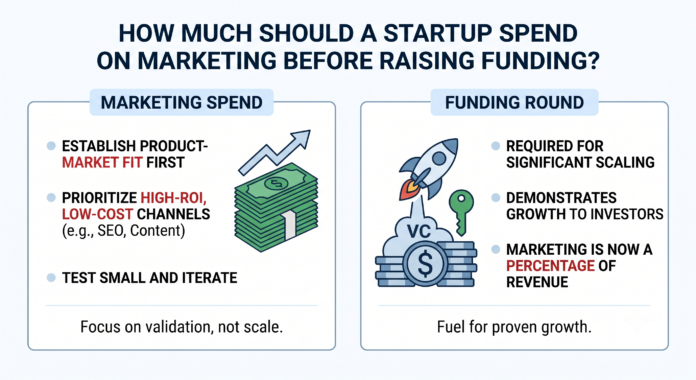
The most expensive mistake early-stage founders make before raising institutional capital is confusing a marketing budget with a growth engine.
When founders assemble their first financial model, they often treat marketing as a linear dial: insert ₹5 lakh, produce ₹15 lakh in booked revenue, show a steep up-and-to-the-right chart, and watch venture capitalists compete for the term sheet.
That playbook belongs to an era of cheap capital that no longer exists.
In today’s venture landscape, growth that comes at the expense of runaway customer acquisition costs (CAC) is viewed as a liability, not an asset. Investors aren’t looking for proof that you can buy revenue with paid ads. They are looking for proof that your product naturally pulls demand and that you have uncovered at least one customer acquisition channel that scales predictably.
Before you raise your next round, your marketing budget has only one job: to buy data and prove repeatability with the minimum possible drain on your runway.
Here is how to calculate that figure, structure your spending across stages, and avoid burning cash on vanity channels.
The Core Rule: Minimum Viable Traction
Before diving into stage-by-stage breakdowns, anchor your planning to two fundamental operational caps:
- If you are pre-revenue: Never allow total marketing spend to exceed 20% to 30% of your total monthly burn. If your operating burn is ₹6 lakh a month, your absolute ceiling for marketing experiments is ₹1.2 lakh to ₹1.8 lakh. The remaining 70% to 80% belongs to engineering, product validation, and operational survival.
- If you are generating revenue: Peg your budget between 10% and 25% of your Annual Recurring Revenue (ARR), depending on whether you are running a high-touch B2B sales cycle or a volume-driven consumer platform.
       PRE-REVENUE RUNWAY ALLOCATION
+-------------------------------------------------------+
|  Product, Engineering & Core Operations: 70% – 80%    |
+---------------------------+---------------------------+
                            | Marketing & Acquisition:  |
                            | 20% – 30% MAX             |
                            +---------------------------+
Spending less than this leaves you without statistically significant data to show investors. Spending more means you are subsidizing unvalidated unit economics with precious equity.
Marketing Spend Benchmarks by Funding Stage
Different rounds demand different proof points. A pre-seed investor wants evidence of customer problem validation; a Series A investor expects a repeatable acquisition machine.
1. Pre-Seed Stage: Spending to Learn, Not to Scale
- Typical spend: ₹15,000 to ₹50,000 per month ($200 to $600/month)
- Target milestone: Clear message-market fit and qualitative proof of willingness to pay.
At this stage, you do not have a distribution problem; you have a validation problem. Putting money into performance marketing campaigns at pre-seed is like pouring premium fuel into a car that doesn’t have an engine yet.
Where money should go:
- Foundational infrastructure: A clean domain, a high-converting landing page builder (Webflow, Framer), and reliable analytics (PostHog, Mixpanel, or Google Analytics 4): ₹15,000–₹25,000/month.
- Micro-experiments: Small, highly targeted ad campaigns (capped at ₹20,000 total) designed solely to test which value propositions drive higher click-through rates.
- Founder-led organic distribution: Writing technical teardowns on Substack or LinkedIn, answering queries in specialized subreddits, and direct cold outreach: Cost = Founder time, not money.
What to avoid:
- Hiring an external PR agency (virtually zero ROI before product-market fit).
- Brand redesigns or bespoke visual identities.
- Retaining full-service performance agencies.
2. Seed Stage: Proving Channel Repeatability
- Typical spend: ₹3 lakh to ₹10 lakh per month ($3,500 to $12,000/month), representing 15% to 25% of total capital deployed.
- Target milestone: At least one scalable acquisition channel with an LTV:CAC ratio greater than 3:1 and a payback period under 12 to 18 months.
Once you have closed a seed round or modest angel check, your mandate shifts from “Do people want this?” to “Can we reliably acquire customers through a repeatable system?”
           TYPICAL SEED-STAGE MONTHLY BUDGET (₹6 LAKH TOTAL)

  Paid Performance (2-3 focused channels)  |████████████████████| ₹2.5L (42%)
  Content & Organic Demand Gen             |███████████| ₹1.4L (23%)
  Marketing Stack & Data Attribution       |██████| ₹0.8L (13%)
  Contractor / Specialist Execution        |████████| ₹1.0L (17%)
  Community / Niche Events                 |██| ₹0.3L (5%)
Where money should go:
- Structured channel testing: Running methodical paid experiments across two primary platforms (e.g., LinkedIn Ads for B2B enterprise; Meta and Google Search for self-serve or consumer).
- Deep content and SEO: High-intent product comparison pages, technical case studies, and documentation that capture users already searching for a solution.
- Contract specialists over broad generalists: Instead of hiring a high-salary VP of Marketing, hire a specialized contractor or fractional growth lead to configure your attribution and build out your primary channel.
3. Approaching Series A: Demonstrating Unit Economic Scale
- Typical spend: ₹15 lakh to ₹45 lakh per month ($18,000 to $55,000/month), or roughly 15% to 25% of ARR.
- Target milestone: Multiple predictable channels operating profitably at volume.
Series A investors look for a predictable formula: if they inject ₹25 crore into your business, can your go-to-market engine efficiently absorb that capital without your customer acquisition costs doubling?
Where money should go:
- Scaling validated channels: Increasing budgets on campaigns where the payback window is strictly under 12 months.
- Core in-house hires: Bringing on full-time product marketers, demand generation managers, and marketing operations specialists.
- Brand authority and category positioning: Targeted industry sponsorships, customer conferences, and original research reports that cement your market position.
The Three Unit Economic Tests Every Investor Checks
When prospective investors inspect your financials, they will evaluate your marketing spend through three core operational lenses. If these numbers fail, an impressive top-line growth rate won’t save your pitch.
1. The LTV:CAC Ratio (Target: 3:1 or Higher)
$$\text{LTV:CAC} = \frac{\text{Customer Lifetime Value}}{\text{Fully Loaded Customer Acquisition Cost}}$$
- Below 2:1: You are burning capital to acquire unprofitable revenue. Scaling this model will accelerate your path to bankruptcy.
- 3:1 to 5:1: The optimal range for venture-backed growth. It demonstrates that customer retention and monetization comfortably outpace your sales and marketing costs.
- Above 6:1: Counterintuitively, this can signal a problem. It often indicates that management is under-investing in acquisition and leaving market share open to faster-moving competitors.
The “Fully Loaded” Requirement: A common mistake early founders make is calculating CAC by simply dividing direct ad spend by new customers. Investors will demand Fully Loaded CAC, which factors in agency retainers, software tools, sales commissions, and the salaries of everyone involved in marketing and sales.
2. CAC Payback Period (Target: Under 12 to 18 Months)
$$\text{CAC Payback (Months)} = \frac{\text{Fully Loaded CAC}}{\text{Gross Margin per Customer per Month}}$$
CAC Payback measures cash velocity—specifically, how many months it takes for a customer to generate enough gross profit to pay back the capital you spent to acquire them.
| Business Model | Healthy Payback | Acceptable Range | Danger Zone |
| SMB B2B SaaS | < 9 Months | 9 – 12 Months | > 14 Months |
| Mid-Market / Enterprise B2B | < 12 Months | 12 – 18 Months | > 20 Months |
| Consumer / D2C (High Repeat) | < 3 Months | 4 – 6 Months | > 8 Months |
If your CAC payback exceeds 18 months at the seed stage, your working capital requirements will balloon as you try to scale. You will exhaust your bank balance waiting for prior cohorts to return the cash needed to fund new growth.
3. The Burn Multiple
$$\text{Burn Multiple} = \frac{\text{Net Burn}}{\text{Net New ARR}}$$
While the Burn Multiple evaluates your entire operating structure, it reflects the efficiency of your marketing and go-to-market teams. If your startup burns ₹2 crore in net cash over six months and generates only ₹50 lakh in net-new ARR, your Burn Multiple sits at an alarming 4.0x.
Top-tier institutional investors look for companies operating at a Burn Multiple below 1.5x, with anything under 1.0x considered elite.
Business Model Variations: B2B SaaS vs. Consumer Platforms
How you balance your budget depends heavily on whether your product is sold to businesses or individuals.
+--------------------------+-------------------------------------+-------------------------------------+
| Characteristic           | B2B SaaS Startups                   | Consumer & D2C Startups             |
+--------------------------+-------------------------------------+-------------------------------------+
| Typical Marketing Share  | 10% – 20% of total burn             | 25% – 40% of total burn             |
| Sales Cycle Duration     | 30 to 90+ days                      | Minutes to days                     |
| Primary Cost Driver      | Content, ABM, sales enablement      | Paid social, search, creator ads    |
| Primary Bottleneck       | Pipeline velocity & deal closing    | Retention & churn management        |
| CAC Dynamic              | High upfront, offset by high ACV    | Low upfront, vulnerable to ad drift |
+--------------------------+-------------------------------------+-------------------------------------+
In B2B models, marketing often acts as air cover for a direct sales team. Much of your budget goes toward collateral, customer case studies, product interactive demos, and targeted outbound tools.
In consumer models, marketing is the product storefront. Spending higher percentages on direct-response ads is common, but only if early cohorts show strong retention and organic referral loops.
A Practical 90-Day Pre-Fundraising Marketing Plan
If you plan to enter the market for a funding round in four to six months, use this 90-day framework to build the operational data room investors want to see.
  MONTH 1: Foundation & Baseline Tests (Budget: ₹1.5 Lakh)
  ├── Configure clean event tracking and conversion attribution
  ├── Interview 15 active users to extract high-converting messaging hooks
  └── Run small ₹15,000 ad experiments across 2 distinct channels to baseline CAC

  MONTH 2: Channel Consolidation (Budget: ₹1.5 Lakh)
  ├── Cut the lower-performing channel completely
  ├── Funnel 70% of acquisition spend into the winning channel
  └── Publish 2 comprehensive customer case studies highlighting measurable ROI

  MONTH 3: Cohort & Payback Verification (Budget: ₹1.5 Lakh)
  ├── Measure 60-day retention and activation rates for Month 1 cohorts
  ├── Reconcile your Fully Loaded CAC and exact payback timeline
  └── Package channel unit economics directly into your pitch deck appendix
Warning Signs You Are Overspending on Marketing
Keep an eye on these four operational red flags before booking investor meetings:
- Top-Line Growth with Exploding CAC: You are adding revenue every month, but the marginal cost to acquire each new rupee of ARR is rising. This shows that your target audience is shallow and that your initial channels are fatiguing.
- Paid Ads Masking a Retention Problem: If customers churn after three months, increasing your marketing budget to replace them is like pouring water into a leaking bucket. Stop marketing spend and fix onboarding, activation, and core product value first.
- No Clear Channel Attribution: If a founder cannot look at their dashboard and point out which specific campaigns, landing pages, or keywords produced their last 25 paying customers, their marketing budget is being managed by guesswork.
- Premature Brand Expenditure: Spending venture capital on billboard campaigns, agency-produced brand anthems, or expensive event sponsorships before your core acquisition engine is humming rarely delivers measurable pipeline.
Sources
- OpenView Partners: SaaS Benchmarks Report
- David Sacks / Craft Ventures: The Burn Multiple Framework
- Tomasz Tunguz: The Mechanics of Customer Acquisition Payback Periods
- Y Combinator Startup Library: How to Set and Manage Growth Budgets
Frequently Asked Questions
What percentage of revenue should an early-stage startup spend on marketing?
Early revenue-generating startups typically allocate between 10% and 25% of their ARR to marketing. Pre-revenue startups should cap marketing expenditures at 20% to 30% of their total monthly operating burn to protect their cash runway.
Is it acceptable to raise a seed round with zero marketing spend?
Yes. Many business-to-business (B2B) startups raise successful seed rounds powered entirely by founder-led sales, organic developer adoption, and direct industry networks. In fact, proving you can secure your first 10 to 20 enterprise pilot accounts without paid advertising is a massive signal of organic product-market pull.
How do investors calculate fully loaded CAC?
Investors combine all expenses incurred in acquiring new customers over a specific period—including paid media spend, marketing software tools, agency fees, sales commissions, and the full salaries and benefits of the marketing and sales teams—and divide that total by the number of new customers acquired during that period.