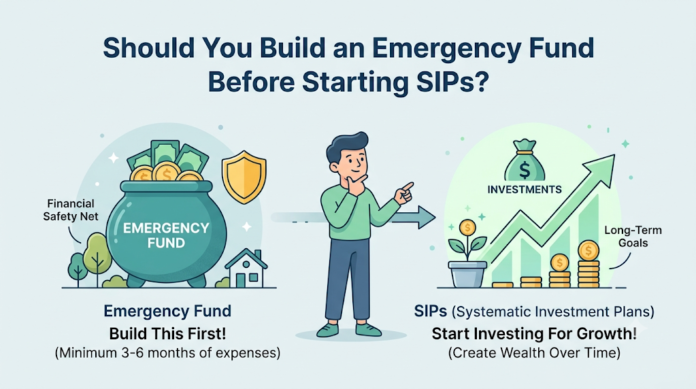
If you have a surplus of ₹5,000 or ₹10,000 sitting in your bank account at the end of the month, the pressure to make it “work” is intense. Financial media endlessly celebrates the compounding power of equity Systematic Investment Plans (SIPs). Charts show small monthly contributions transforming into multi-crore retirement pots, while traditional savings accounts are dismissed as wealth destroyers losing ground to inflation.
This messaging leads many beginners to ask a straightforward question: Should you build an emergency fund before starting SIPs, or can you dive straight into investing and deal with life as it happens?
The classic financial planning answer is uncompromising: always build a complete 3 to 6-month emergency fund before touching an equity SIP.
Yet in practice, telling a 23-year-old earning their first paycheck to spend two full years hoarding cash in a 3% savings account before buying a single mutual fund unit often backfires. They either get bored and stop saving altogether, or they ignore the advice entirely, invest every spare rupee into equities, and get wiped out by the first hospital bill or sudden career shift.
The answer is not a rigid binary choice. To protect your capital without losing the crucial early years of compounding, you need to understand the structural physics of both tools—and how to run them in parallel without shooting yourself in the foot.
The Forced Liquidation Trap: Why Equities Make Terrible Cushions
The most dangerous assumption a new investor can make is treating an equity mutual fund as an emergency fund with a better return.
The logic sounds sensible on the surface: “If a crisis strikes, mutual fund redemptions process in two business days anyway. Why leave money idle earning modest interest when it could be growing in the market?”
Here is why that logic fails when applied to the real world: emergencies and stock market corrections are frequently caused by the exact same macroeconomic shocks.
          THE FORCED REDEMPTION CYCLE (INVESTOR A)

  [ Economic Downturn ] ──► [ Equity Market Falls 20% ]
           │
           ▼
  [ Job Loss / Pay Cut ] ──► [ Emergency Expenses Hit ]
           │
           ▼
  [ Zero Cash Buffer ] ──► [ Forced SIP Liquidation at Market Low ]
                                    │
                                    ▼
                         [ Capital Destroyed Permanently ]
When economies hit headwinds, companies retrench staff, freeze bonuses, or cut contractor payouts. At that precise moment, the benchmark indices are rarely sitting at all-time highs; they are often down 15%, 20%, or 30%.
Consider two colleagues, Aakash and Priya, each with ₹10,000 in monthly investable surplus:
- Aakash puts all ₹10,000 into an equity SIP from Day 1. After six months, he has deployed ₹60,000. A sharp market correction pulls his portfolio value down by 15% to ₹51,000. That exact week, his car engine suffers a catastrophic failure, requiring ₹50,000 in immediate repairs. With zero cash reserves, he has to redeem almost his entire mutual fund portfolio to pay the mechanic. He locks in a permanent capital loss, faces potential exit loads, and resets his investing journey back to zero.
- Priya splits her monthly allocation. She parks ₹5,000 into a liquid fund and routes ₹5,000 into an index SIP. When the same car problem strikes, she pulls from her liquid reserves. Her equity units remain untouched, allowing compounding to do its job uninterrupted through the recovery cycle.
An emergency fund is not an investment designed to beat inflation. It is portfolio insurance. Its job is not to deliver returns, but to stand between your equity portfolio and life’s unexpected disruptions.
How Big Does Your Buffer Actually Need to Be?
The conventional advice of “3 to 6 months of expenses” is a broad starting point, but it ignores real-life variability. A single software engineer living in shared housing with financial support from parents has completely different exposure than a sole breadwinner with dependents and a home loan.
A clearer way to size your liquidity target is the 3-6-9 Framework:
| Life & Employment Situation | Target Cushion | Why This Number? |
| Salaried, Single, Low Liabilities | 3 Months of core expenses | High mobility, single failure point, fast re-employment turnaround |
| Dual-Income Household, Stable Jobs | 3–4 Months of core expenses | Structural redundancy—one income covers basic survival if the other stops |
| Sole Earner with Dependents / EMIs | 6 Months of core expenses | A disruption impacts multiple lives; loan defaults carry compounding penalties |
| Freelancer, Consultant, Business Owner | 9–12 Months of core expenses | High income volatility, seasonal droughts, irregular client payment cycles |
What Counts as an “Essential Expense”?
When calculating this figure, ignore your credit card statement’s total balance. An emergency budget measures survival, not lifestyle maintenance.
- Include: Rent or mortgage EMI, essential groceries, utilities (power, water, gas, baseline internet), mandatory insurance premiums (health and life), non-deferrable loan installments, and dependants’ school fees.
- Exclude: Restaurant dining, weekend travel, streaming subscriptions, discretionary shopping, and annual vacation savings.
If your household requires ₹45,000 per month to keep the lights on and the pantry stocked, a 3-month buffer is ₹1.35 lakh, while a 6-month buffer is ₹2.70 lakh.
Where to Park Your Safety Net: The Liquidity Hierarchy
The golden rule of emergency reserves is absolute: Safety and immediate accessibility always take precedence over yield.
If your emergency fund is locked behind penalty walls or subject to capital volatility, it is not an emergency fund. It is just another risky asset.
+─────────────────────────────────────────────────────────────────────────────+
|                        TIER 1: THE INSTANT BUFFER                           |
|  Location: High-yield Savings Account or Sweep-in Bank FD                   |
|  Allocation: ₹25,000 to ₹50,000 (or 1 month of expenses)                    |
|  Access: Under 60 seconds via UPI / ATM card                                |
+─────────────────────────────────────────────────────────────────────────────+
                                       │
                                       ▼
+─────────────────────────────────────────────────────────────────────────────+
|                        TIER 2: THE CORE DEFENSE                             |
|  Location: Liquid Mutual Funds / Overnight Funds / Multi-deposit FDs        |
|  Allocation: Remaining 2 to 5 months of living expenses                     |
|  Access: T+1 business day redemption directly to your primary bank          |
+─────────────────────────────────────────────────────────────────────────────+
1. High-Yield Savings or Sweep-in Fixed Deposits (Tier 1)
Keep your initial ₹25,000 to ₹50,000 directly inside an everyday savings account or a sweep-in (“flexi”) bank deposit. This covers sudden midnight emergencies—a hospital admission copay, emergency travel, or plumbing disasters—where funds are needed within 15 minutes via UPI or a debit card.
2. Liquid Mutual Funds (Tier 2)
The remainder of your reserve belongs in high-quality debt instruments like liquid mutual funds (schemes investing in sovereign debt and AAA commercial paper with maturities under 91 days) or short-term fixed deposits.
Liquid funds typically offer slightly better yields than conventional savings accounts, have negligible interest rate risk, and credit redemptions back to your account within one business day (T+1). Most fund houses also offer instant redemption facilities up to ₹50,000 (or 90% of the folio value) within minutes.
What Never Belongs in an Emergency Fund
- Equity Mutual Funds / Shares: Far too volatile during market downturns.
- Gold / Gold ETFs: Selling physical gold involves valuation haircuts and making-charge losses, while Gold ETFs are subject to commodity price swings and settlement cycles.
- Real Estate: Completely illiquid; you cannot sell a balcony to pay a dental bill.
- Employee Provident Fund (EPF): Dedicated strictly to retirement; withdrawals require administrative processing, documentation, and specific legal justifications.
- Credit Cards: Relying on revolving credit cards (running 36% to 42% annual interest rates) during a prolonged crisis transforms an income disruption into an inescapable debt spiral.
The Hybrid Implementation: Building Both Simultaneously
You do not need to choose between sitting in complete cash or diving headfirst into market volatility. For most first-time earners, the most effective behavioral strategy is a Parallel Allocation Model.
Instead of waiting months or years to build a fortress-level emergency fund before touching an equity SIP, implement this phased transition:
  PHASE 1: The Starter Buffer (Months 1–3)
  ├── 100% of savings directed to a high-yield savings account or sweep FD
  └── STOP once you hit ₹25,000 to ₹50,000 (roughly 1 month of expenses)

  PHASE 2: The Parallel Split (Months 4–12)
  ├── 60% of monthly surplus ──► Liquid Fund / Sweep FD (Building toward 3–6 months)
  └── 40% of monthly surplus ──► Broad Equity Index SIP (Starting the compounding clock)

  PHASE 3: Full Compounding Velocity (Ongoing)
  ├── Emergency fund hits the full 3–6 month target
  └── 100% of future monthly surplus ──► Long-term investments (SIPs, goals, PPF)
This sequence solves the primary behavioral friction of personal finance: momentum.
Phase 1 provides immediate breathing room so a routine car repair doesn’t push you into credit card debt. Phase 2 gets your foot in the door of equity markets, building the habits of watching market volatility and understanding NAV movements without staking your survival on it. Phase 3 unleashes maximum capital growth on top of a rock-solid foundation.
What Comes First? The Complete Financial Checklist
Before picking specific funds or trying to optimize your investment returns, walk your finances through this structural hierarchy:
- The Starter Buffer: Hold ₹25,000 to ₹50,000 in your savings account. Never let this balance drop to zero.
- Comprehensive Health Insurance: Secure an independent family floater or individual health policy (minimum ₹5–10 lakh cover). Do not depend solely on employer-provided health cover, which vanishes the day you change jobs or face retrenchment.
- Pure Term Life Insurance: If you have financial dependents, buy a plain term life policy covering 10 to 15 times your annual income. Avoid mixed investment-insurance products like ULIPs or endowment plans.
- Clear High-Cost Debt: Pay off credit card balances and high-interest personal loans aggressively. Earning 12% in the stock market while paying 36% on revolving card debt is a guaranteed net loss.
- Fund the Core Safety Net: Complete your 3 to 6-month living expense reserve inside liquid instruments.
- Deploy Long-Term SIPs: Route surplus capital into low-cost broad market index funds and diversified equities with a 7 to 10-year investment horizon.
The Verdict
Should you build an emergency fund before starting SIPs? Yes—at least a starter version.
Trying to build long-term wealth without a cash reserve is like building a house without a foundation. One bad monsoon, and the entire structure comes crashing down.
Take a breath, establish your initial liquid buffer first, split your surplus to keep your compounding momentum alive, and lock in the peace of mind that allows you to remain calm when the markets inevitably swing.
Important ReSources
- Association of Mutual Funds in India (AMFI): Understanding Liquid Funds & Investor Guidelines
- Securities and Exchange Board of India (SEBI): Investor Education Portal
- Reserve Bank of India (RBI): Financial Education Resources
Frequently Asked Questions
Can I consider my credit card limit as my emergency fund?
No. Credit cards are short-term convenience tools, not emergency funds. If you lose your income or face a protracted medical emergency, charging living costs to a card creates high-interest debt compounding at 36% to 42% annually, turning an operational emergency into a debt trap.
Is a fixed deposit better than a liquid fund for an emergency fund?
Both work well, but they serve slightly different needs. Sweep-in bank fixed deposits offer immediate, round-the-clock liquidity via ATMs and net banking. Liquid mutual funds often offer slightly higher post-tax yields and avoid premature withdrawal penalty deductions, making them ideal for the secondary layer of your reserve.
What should I do if I have to use part of my emergency fund?
Pause or temporarily reduce your monthly equity SIP contributions and redirect your cash flow toward replenishing the emergency fund. Once the liquid reserve returns to its baseline target, resume your regular investment allocations.